VoxCPM2 - Tokenizer-Free Multilingual Text-to-Speech with Voice Design and Voice Cloning
VoxCPM2 — tokenizer-free multilingual text-to-speech with voice design and cloning
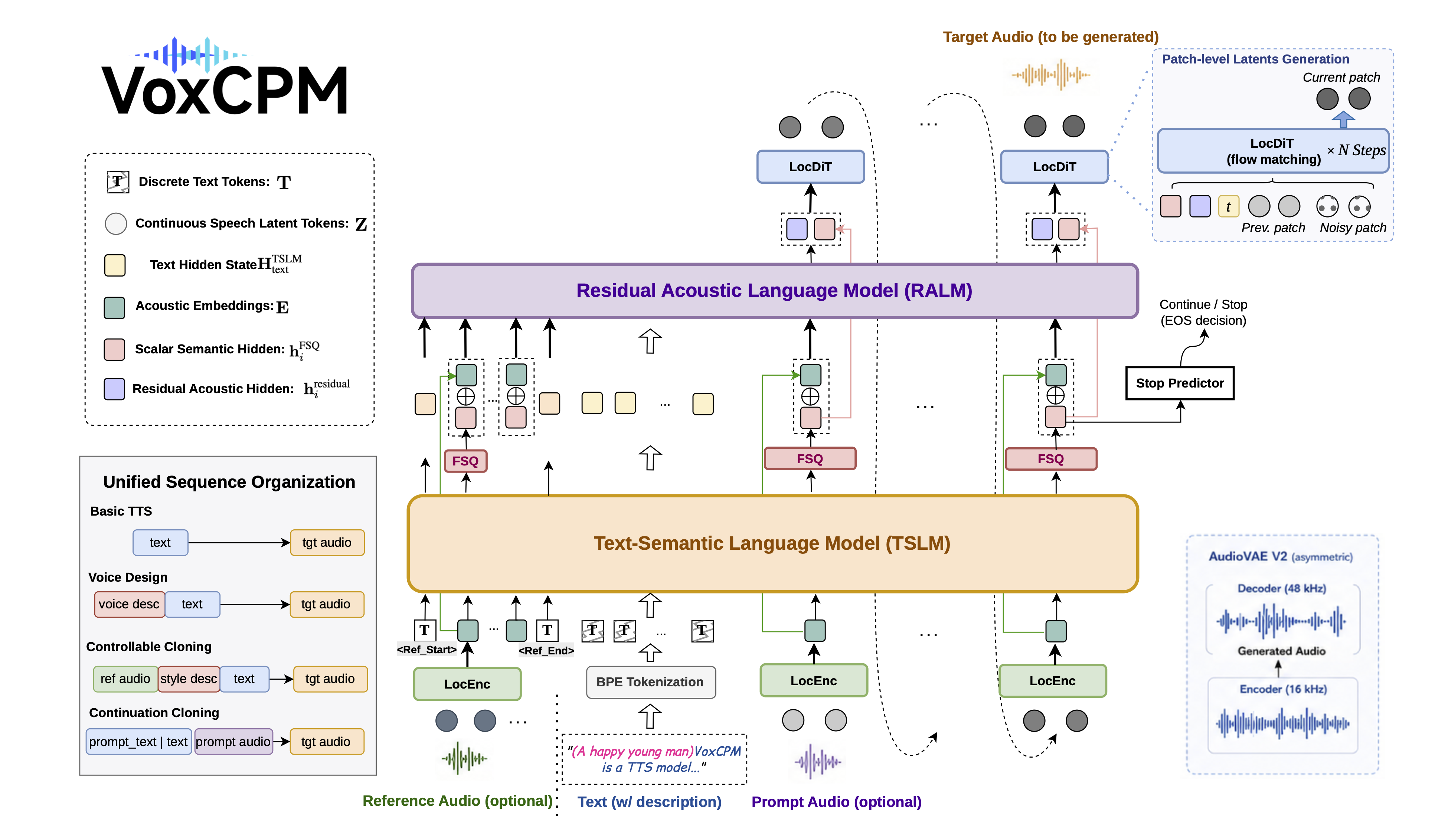
VoxCPM2 is the latest major release of OpenBMB's VoxCPM, a tokenizer-free text-to-speech (TTS) system that directly generates continuous speech representations through an end-to-end diffusion autoregressive architecture, bypassing discrete tokenization. It is a 2B parameter model trained on over 2 million hours of multilingual speech, built on a MiniCPM-4 backbone, and released under the Apache-2.0 license (free for commercial use).
Announced April 2026, VoxCPM2 supports 30 languages without language tags, voice design (synthesize a brand-new voice from a natural-language description, no reference audio needed), controllable voice cloning from a short reference clip with steerable emotion/pace/style, 48 kHz studio-quality output via AudioVAE V2, and real-time streaming (RTF as low as ~0.3 on an RTX 4090).
Key capabilities
- 30-language multilingual TTS — Arabic, Burmese, Chinese, Danish, Dutch, English, Finnish, French, German, Greek, Hebrew, Hindi, Indonesian, Italian, Japanese, Khmer, Korean, Lao, Malay, Norwegian, Polish, Portuguese, Russian, Spanish, Swahili, Swedish, Tagalog, Thai, Turkish, Vietnamese (plus Chinese dialects such as Cantonese and Sichuanese).
- Voice Design — create a new voice from a description (gender, age, tone, emotion, pace) with no reference audio.
- Controllable cloning — clone timbre from a short reference clip and steer emotion, pace and expression with optional style guidance.
- Ultimate cloning — provide reference audio plus its transcript for seamless continuation preserving every vocal nuance.
- 48 kHz studio-quality audio — 16 kHz reference in, 48 kHz output out via AudioVAE V2 asymmetric encode/decode with built-in super-resolution.
- Context-aware prosody and real-time streaming (~0.3 RTF on RTX 4090; faster with Nano-vLLM / vLLM-Omni).
Quick start
Install pip install voxcpm (Python ≥ 3.10, PyTorch ≥ 2.5.0, CUDA ≥ 12.0) and generate:
from voxcpm import VoxCPM
import soundfile as sf

model = VoxCPM.from_pretrained("openbmb/VoxCPM2", load_denoiser=False)
wav = model.generate(
    text="VoxCPM2 is a tokenizer-free multilingual text-to-speech model.",
    cfg_value=2.0,
    inference_timesteps=10,
    seed=42,
)
sf.write("demo.wav", wav, model.tts_model.sample_rate)
Links
- GitHub — OpenBMB/VoxCPM (code, weights, training/fine-tuning scripts)
- Hugging Face — openbmb/VoxCPM2 (model weights)
- Live demo (Hugging Face Spaces)
- Documentation (ReadTheDocs)
- Audio samples / demo page
- VoxCPM2 technical report (arXiv:2606.06928)
Honest limits
- Voice cloning quality depends on the reference audio quality and length; results vary by speaker and language.
- GPU with CUDA ≥ 12 is recommended; CPU inference is not the intended deployment path.
- As a generative voice model, outputs should be reviewed before use in production (pronunciation, prosody, speaker consistency).